Garlic — Botanical Characteristics, Cultural History, and Research Overview
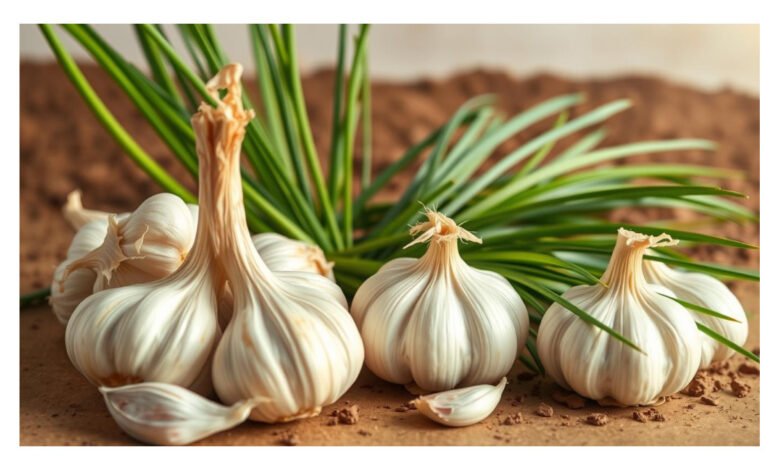
Have we been carrying a small but mighty record of human culture and science in our kitchen drawers for millennia?
Allium sativum L. is the plant we call garlic. It grows in gardens and stores. It comes from Central and South Asia, including the Black Sea area and the Hindu Kush.
Garlic also grows wild in parts of Europe. It has an erect flowering scape and flat leaves. Its bulbs have 10–20 cloves, making it easy to use.
Garlic’s history goes back over 5,000 years. It traveled along the Silk Road and around the world. Now, China makes most of the garlic, but there are many varieties and subspecies.
Today, scientists study garlic. They look at its genetics, chemistry, and nutrition. We want to share what we know about garlic’s botany, history, and research.
Key Takeaways
- Allium sativum L. is a bulbous perennial native to parts of Central and South Asia and Mediterranean Europe.
- Garlic history spans over 5,000 years, with global spread via trade routes like the Silk Road.
- Hundreds of varieties exist—two main subspecies—and China leads global production.
- Garlic research links taxonomy, morphology, and phytochemistry to culinary and cultural use.
- We present scientific information on garlic nutrition and botany without making therapeutic claims.
Taxonomic classification and nomenclature of the species
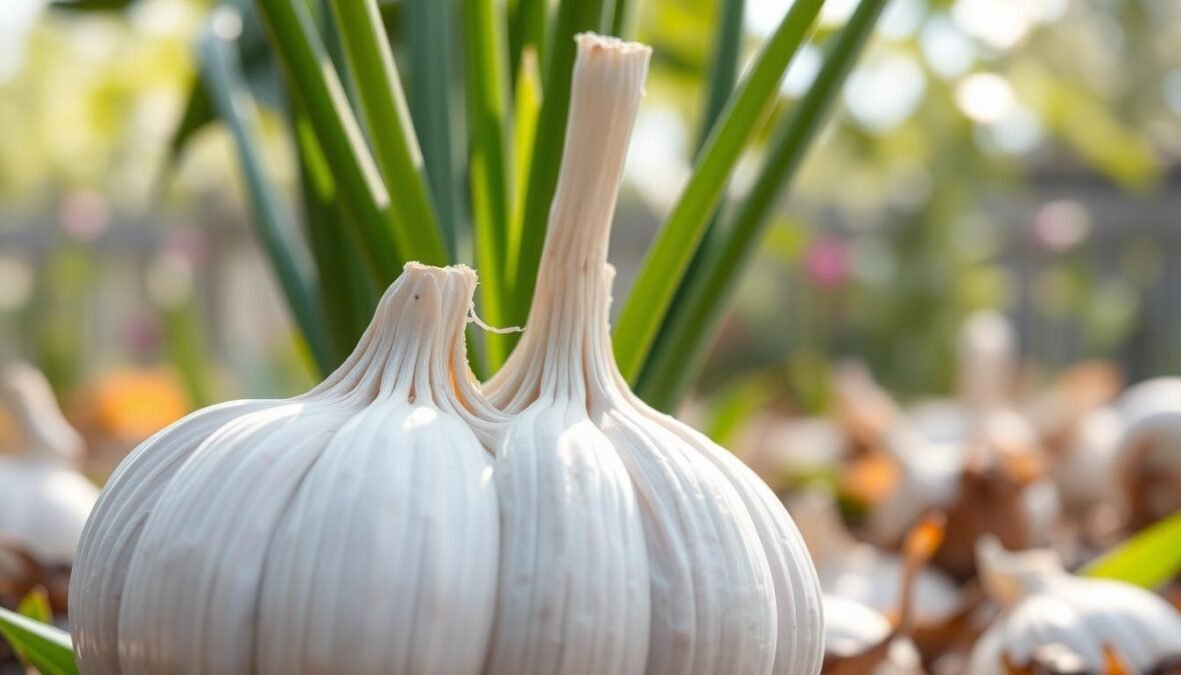
We start by placing cultivated garlic in plant systems. This gives us a solid foundation for those seeking precise, science-based info. The name Allium sativum L. is widely accepted in modern floras. It helps guide discussions on garlic taxonomy and supports lab and herbarium work.
Here’s the scientific classification hierarchy for garlic. It shows where garlic fits among monocots and in the Amaryllidaceae family. This hierarchy supports consistent use of the Allium sativum classification in research and horticulture.
- Kingdom: Plantae
- Clades: Tracheophytes, Angiosperms, Monocots
- Order: Asparagales
- Family: Amaryllidaceae
- Subfamily: Allioideae
- Genus: Allium
- Subgenus: A. subg. Allium
- Species: Allium sativum
Taxonomic treatments can vary. It’s important to keep up with herbarium records and molecular data when using garlic nomenclature. The debate over varietal names and distinct species affects how we cite Allium sativum in floras and germplasm catalogs.
Older literature lists synonyms and labels that appear in botanical indexes and specimen sheets. These names show past interpretations and regional uses. Knowing them helps avoid misidentification when looking at legacy collections.
- Allium arenarium Sadler ex Rchb. (1830)
- Allium controversum Schrad. ex Willd.
- Allium longicuspis Regel
- Allium ophioscorodon Link
- Allium pekinense Prokh.
- Porrum ophioscorodon (Link) Rchb.
- Porrum sativum (L.) Rchb. (1830)
Elephant garlic is often confused with true garlic but is actually Allium ampeloprasum. This distinction is important for seed banks, culinary use, and breeding programs focused on garlic taxonomy and genetic identity.
Many cultivated lines are sterile or reproduce asexually. This makes it hard to link modern cultivars with a single wild progenitor. Genetic and morphological studies suggest a close relationship with Middle Eastern Allium species. This uncertainty affects how we apply garlic nomenclature in conservation and breeding.
When using botanical names in publications, rely on recent molecular phylogenies and verified herbarium vouchers. This ensures the most accurate use of garlic scientific name and taxonomy for your projects.
Genetic diversity and subspecies structure
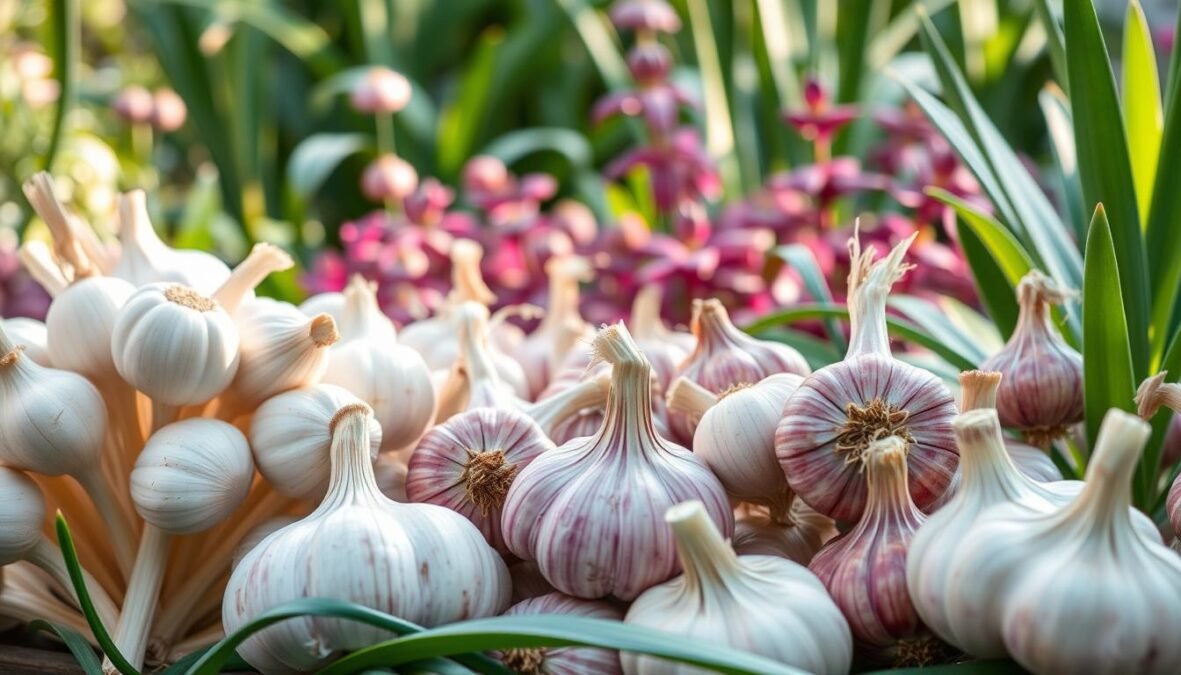
We look at how garlic diversity spreads across landscapes and farms. It comes from inherited traits, human choice, and local traditions. Over time, farmers picked certain traits, leading to the garlic we know today.
These choices shaped garlic into different subspecies. Now, we see many locally grown landraces in Central Asia, the Mediterranean, and Yunnan, China.
Primary subspecies and cultivar groups
Garlic is split into two main groups. The hardneck group, like A. sativum var. ophioscorodon, includes types like porcelain and purple stripe. They’re known for their strong flavor and scapes.
The softneck group, A. sativum var. sativum, includes artichoke types. They’re good for long storage and have braided bulbs.
There are about ten major cultivar groups and hundreds of local varieties. Garlic cultivars vary from softnecks with many cloves to single-clove types from Yunnan. This variety comes from natural differences and selective breeding for traits like bulb size and skin color.
Genetic challenges due to sterility and asexual propagation
Asexual propagation by cloves is common in farming. It keeps good traits but limits mixing of genes. Many garlic types are sterile or have low fertility, making breeding hard.
Geneticists use special tools to overcome these challenges. They use molecular markers, map clonal lines, and study mutations. By comparing cultivated garlic with wild relatives, they understand where traits come from and where diversity is greatest. This is important for breeding, disease resistance, and saving garlic varieties.
Morphology and developmental anatomy
We look at garlic’s visible parts and what’s under the skin. This is what gardeners and scientists study to understand different types of garlic. Knowing about garlic’s anatomy helps us see why some are better for planting, storing, or cooking.
Bulb and clove structure
The bulb is a compact storage organ with a basal plate and layers around it. Most bulbs have ten to twenty cloves, arranged around a central point on the basal plate. Inner cloves are usually more symmetrical, while outer ones can be less so.
Cloves are covered by inner leaves and several outer protective layers. The color of these layers, the number of cloves, and if a bulb has only one clove are important for identifying garlic types in catalogs and scientific guides.
Vegetative and reproductive organs
Vegetative parts include flat, linear leaves with sharp tips. These leaves are about 1.25 to 2.5 cm wide. The flowering stem, or scape, can grow up to one meter tall in some varieties. Traits of leaves and scapes often show how much cold the plant has experienced.
Garlic flowers have both male and female parts; they are usually pink to purple. Some hardneck garlics grow bulbils instead of seeds in their flowers. The presence of a scape, the type of flower, and if bulbils form are key to identifying garlic types.
Developmental anatomy shows how cold affects garlic’s growth. Cold exposure can change how many cloves a bulb has, its shape, and how tall the scape grows. These changes are important for scientists to understand and classify garlic types.
Ecology and geographic origin
We explore where garlic comes from by looking at where wild and farmed garlic meet. By studying garlic’s environment, we learn how climate, soil, and human travel have shaped today’s crops. This knowledge helps us protect garlic and make better choices for farmers and seed keepers.
Native range and centers of diversity
Studies show garlic’s roots are in Central and South Asia. From the Black Sea to the Hindu Kush, early farming created many varieties. These early farms were key to garlic’s diversity.
Central Asia is where garlic’s diversity shines. It’s home to many traditional garlic types, shaped by local weather and farming. Saving these varieties helps garlic stay strong over time.
Naturalization and global distribution
Garlic traveled far, carried by the Silk Road and later by sea and colonies. Now, China grows most of the world’s garlic, supplying about three quarters of it.
In places like Mediterranean Europe, garlic has made itself at home. Wild garlic relatives can be found in Britain and North America. Elephant garlic shows how other garlic types join our gardens and markets.
| Region | Characteristics | Conservation priority |
|---|---|---|
| Central Asia | High garlic biodiversity, many landraces, varied microclimates | Top priority for germplasm collection and in situ preservation |
| Southwest Asia (Caucasus, Iran) | Historical domestication sites, mixed wild-cultivated populations | Important for genetic studies and trait recovery |
| Mediterranean Europe | Naturalized populations, long cultivation history, wild Allium species | Monitor hybridization and protect wild relatives |
| East Asia (China) | Large-scale cultivation, major global market influence | Ex situ conservation and sustainable production research |
| North America | Introduced cultivars and naturalized wild relatives, varied climates | Regional adaptation studies and seed bank records |
Growth habits, cultivation practices, and propagation methods
Garlic grows as a perennial bulb but is often treated as an annual. Softneck and hardneck garlic types differ. Softnecks have many small cloves, while hardnecks have larger cloves and a flowering scape.
Climate, soil depth, and the type of garlic chosen affect bulb size and clove number. Knowing these growth habits helps gardeners set realistic expectations for using garlic in cooking and medicine.
Garlic is mainly propagated through vegetative division. Planting garlic cloves in well-drained soil allows each clove to grow into a new bulb. It’s important to plant at the right time and ensure firm soil contact for best results.
Container gardening is a good option when space is limited. Use deep pots and a loose potting mix for the best results.
Propagation by division and vernalization requirements
Divide the bulb into individual cloves and plant each clove pointed end up. Vernalization, or exposure to cold, is crucial for proper bulbing in hardneck garlic. Without enough cold, some types may only produce a single large clove.
Research shows that the length of vernalization affects clove number and bulb uniformity. It’s important to follow specific guidance for each cultivar, as hardiness and cold needs vary. In milder winters, softneck cultivars are a better choice for reliable bulb development.
Crop management and harvest timing
Planting depth and spacing impact bulb size. Deeper planting helps in colder climates, while wider spacing can increase bulb size. Removing scapes in hardneck varieties can boost yield by directing energy to bulb growth.
Harvest timing varies by region and garlic type. Leaves turning yellow and falling indicate maturity. Most harvests happen in late spring to early summer in the continental United States. Curing bulbs in a shaded, ventilated space extends storage life and preserves flavor.
- Soil: loose, well-drained, pH 6.0–7.0
- Planting: individual cloves, point up, 2–3 inches deep typical
- Spacing: 4–6 inches between cloves for larger bulbs
- Scape management: remove when present to favor bulb development
- Storage: softnecks store longer; cure before long-term storage
We suggest small experiments to learn what works for your site. Try varying planting dates, depths, or scape removal. Trial data and observation provide valuable insights into growing garlic.
Plant pathology, pests, and disease management
We outline the key threats to garlic and practical steps you can take to protect plantings. Garlic faces persistent soilborne fungi, nematodes, and insect pressures. These threats reduce yield and quality. Sound garlic crop management focuses on prevention—sanitation, careful site selection, and informed monitoring.
Major fungal and nematode threats persist in many production regions. White rot garlic, caused by Stromatinia cepivora, can survive for years in infested soil. It kills cloves in storage and field. Botrytis neck and bulb rot attacks foliage and bulbs during cool, wet weather. Pink root weakens roots and reduces plant vigor. Leek rust can reduce photosynthetic area and lower bulb size. Bulb nematodes form complexes with fungi to worsen damage.
Quarantine and certification programs limit spread where they exist. Sanitation of seed stock and exclusion of infected soil remain primary defenses. Crop rotation with non-hosts helps, though long-lived soil inoculum makes rotation alone insufficient in some fields.
Major fungal and nematode threats
We recommend routine testing of planting material and avoiding fields with known infestations when possible. Use certified, pathogen-tested cloves to lower initial disease pressure. Monitor for early signs—yellowing, stunted growth, or discolored roots—and remove affected plants promptly to reduce inoculum.
Soil health measures—improving drainage, adding organic matter, and encouraging beneficial microbes—can reduce disease expression. Research highlights biological antagonists and compost teas as promising tools when integrated with standard practices.
Insect pests and integrated pest management
Insect pressures include leek moth larvae and leaf miners that feed on foliage and open entry points for fungal infection. Managing insect vectors reduces both direct damage and secondary disease risk. Cultural controls—timely planting, border sanitation, and removal of volunteer Allium species—lower pest load.
Integrated pest management for garlic pests blends monitoring, thresholds, and selective controls. Pheromone traps and regular scouting guide interventions. When treatments are needed, target-specific options preserve beneficial insects and support long-term sustainability.
Resistance breeding remains limited because garlic is mostly vegetatively propagated. This constraint makes preventive crop hygiene and certification programs central to effective garlic crop management. Research continues on biological control agents, improved testing protocols, and soil remediation techniques.
| Threat | Key signs | Primary management steps |
|---|---|---|
| White rot garlic (Stromatinia cepivora) | Basal rot, white mycelial growth on bulbs, long-term soil survival | Use certified seed, avoid infested fields, deep burial of infected bulbs, long rotations, sanitation |
| Botrytis neck and bulb rot | Gray mold on necks, soft bulbs, higher losses in cool wet seasons | Improve air flow, timely curing, remove infected plants, targeted fungicide when justified |
| Pink root | Pink to purple roots, reduced vigor, small bulbs | Rotate to non-hosts, enhance soil health, avoid stressed plants |
| Leek rust | Orange pustules on leaves, defoliation | Sanitation, resistant varieties where available, timely removal of debris |
| Bulb nematodes | Swollen or distorted bulbs, secondary fungal infections | Use clean planting stock, hot-water treatment where appropriate, crop rotation, soil solarization |
| Leek moth and leaf miners | Leaf mining tunnels, larval feeding, secondary infections | Scouting, pheromone traps, biological controls, targeted insecticides when needed |
Phytochemistry and major active compounds
We explore the chemical makeup of garlic, focusing on key compounds and their uses in cooking and research. The chemical makeup changes quickly when garlic is crushed. This is why handling it carefully is important for both analysis and cooking.
At the heart of garlic’s chemistry is alliin, a sulfur amino acid. When garlic cells are broken, alliinase turns alliin into allicin. This happens fast, creating garlic’s sharp smell and taste.
Allicin is very reactive and short-lived. It breaks down into stable sulfur compounds like ajoene and diallyl polysulfides. These compounds are what give garlic its smell and taste, and change when it’s cooked.
But garlic isn’t just about sulfur. It also contains saponins, flavonoids, enzymes, and amino acids. When you cook garlic, heat creates new compounds and colors through chemical reactions.
The type of garlic, how it’s stored, and how it’s processed affect its chemistry. Hardneck and softneck garlics have different smells and chemical levels. This means studies need to control how they handle garlic samples to get accurate results.
Studies often focus on allicin and the compounds it turns into. To get reliable results, they use careful timing, temperature control, and specific tests.
When cooking with garlic, heat reduces its pungency. Slow cooking makes it sweeter and milder. Roasting brings out deeper flavors and more antioxidants.
To keep garlic’s strong flavor, handle it gently. For milder tastes, cook it longer. Both cooks and researchers benefit from knowing how garlic’s chemistry affects its taste and smell.
Analytical methods and research approaches used in garlic studies
We explain how researchers study garlic’s chemistry, genetics, farming, and history. They use clear methods to understand their findings. This makes it easier to compare studies and account for differences in garlic types and how samples are handled.
Phytochemical analysis and standardization
Scientists use chromatography and mass spectrometry to study garlic’s compounds. They focus on sulfur compounds like allicin and S-allylcysteine. It’s important to prepare samples quickly because garlic changes fast after it’s cut.
They use internal standards and calibration curves for accurate measurements. This makes sure studies can be compared, even if they use different types of garlic.
Genetic, agronomic, and ethnobotanical research methods
Genetic studies use SSRs and SNP panels to understand garlic’s family tree. This helps identify different garlic types and their relationships to wild relatives. Because garlic doesn’t breed easily, scientists combine genetic data with farm trials.
Farm trials need the same garlic and controlled conditions to test traits. They use random blocks, many seasons, and consistent harvests to reduce outside influences. This helps map traits and improve garlic farming.
Ethnobotany adds to lab work by studying garlic’s cultural use. Researchers use interviews, old texts, and plant remains to connect traditional uses with scientific findings. This mix of methods links traditional knowledge with modern science.
Reproducibility is key across all fields. Clear reporting of methods and details is crucial. This way, other researchers can repeat studies and grow our understanding of garlic.
Cultural history and documented ancient uses
We explore garlic’s journey from ancient clay models to today’s pantry staples. Archaeology and texts show garlic was key in diets, rituals, and healing across the world. This brief history connects artifacts with written records, revealing garlic’s impact on society and food.
Garlic’s presence is seen in Bronze Age sites and Egyptian tombs. Finds in Central Asia suggest early cultivation. These discoveries highlight garlic’s long history, even before written records.
Written records add to the story. The Ebers Papyrus lists garlic as a medicine and food. Greek and Roman writers talk about its use in food and for workers. Ancient texts from India and China also mention garlic, showing its varied uses.
Over time, garlic recipes varied by region. In East Asia, it was aged to make black garlic. In the Mediterranean, it was eaten raw or roasted. In South Asia, it was used in spiced pastes and fried condiments.
Garlic was used for food, rituals, and daily tasks. In Greece, temples sometimes banned it after meals. Athletes and workers used it for energy. Across cultures, garlic was part of rituals, blending food and symbolism.
To wrap up, we look at archaeological finds, texts, and cooking methods. This gives us a clear picture of garlic’s ancient uses and cultural significance.
| Evidence Type | Geographic Area | Approximate Date | Notable Cultural Role |
|---|---|---|---|
| Clay and botanical remains | Egypt, Central Asia | c. 3700–2000 BC | Funerary offerings; early domestication indicators |
| Medical papyri and treatises | Egypt, China, India | c. 1500–2000 BC | Dietary remedy lists; ritual prescriptions |
| Classical literature | Greece, Rome | c. 700 BC–200 AD | Labor rations; athletic and military dietary use |
| Fermentation traditions | East Asia, Persia | Antiquity to medieval period | Preservation methods; early black garlic precursors |
| Vedic and Ayurvedic records | South Asia | c. 2000 BC onward | Culinary condiments; integrated in food and ritual life |
Traditional nomenclature, folklore, and symbolic roles
Garlic has many names across languages and places. These names show how people lived with the plant. They range from simple food labels to names that tell stories of taste, smell, and power.
In English, garlic is often called the “stinking rose.” This name shows both admiration and honesty about its smell. In Asia and Europe, names like “snake grass” come from beliefs that garlic keeps snakes away. These names mix practical use and symbolic meaning.
Vernacular terms in Russia call garlic “Russian penicillin.” This name shows its role in fighting illness. In the Mediterranean, names highlight its importance in cooking and at family gatherings.
Here’s a quick guide to common garlic names, where they’re used, and what they suggest culturally.
| Common Name | Region / Language | Cultural Role Implied |
|---|---|---|
| Stinking rose | English-speaking Europe and North America | Affectionate acknowledgment of aroma; culinary staple with revered flavor |
| Snake grass | Parts of South and East Asia | Protective folk use against snakes and malevolent forces |
| Russian penicillin | Russia and Eastern Europe | Folk remedy connotation; everyday preventive and supportive food |
| Allium / sativum (vernacular variants) | Widespread across Europe, Middle East | Botanical recognition informing culinary and agricultural practice |
Garlic has deep roots in folklore. In ancient Egypt, it was buried with the dead for the afterlife. The Greco-Romans used it in offerings. In many places, garlic was hung in kitchens to ward off bad luck.
We don’t make health claims from old names. But, the patterns in names and rituals are clear. They show how social views influenced how garlic was grown, shared, and eaten.
Looking into garlic names and rituals reveals its importance. It’s not just a food but a cultural symbol. It has played a big role in history, from markets to shrines, and in recipes and rituals.
Nutritional composition and compositional data
We take a close look at garlic nutrition. This helps you compare different servings with the 100 g reference used in food databases. Raw garlic has a lot of water compared to dry mass. It’s mostly carbohydrates, with a bit of protein and fiber, and very little fat.
It’s rich in vitamin B6, vitamin C, manganese, selenium, and potassium. But, these levels can change based on the garlic type, soil, and how it’s stored.
| Nutrient (per 100 g) | Approximate value | Notes |
|---|---|---|
| Energy | ~149 kcal | Primarily from carbohydrates |
| Carbohydrates | ~33 g | Includes simple sugars and oligosaccharides |
| Protein | ~6.4 g | Modest for a bulb vegetable |
| Dietary fiber | ~2.1 g | Varies with maturity and processing |
| Fat | ~0.5 g | Very low total fat |
| Vitamin B6 | ~1.2 mg | One of the more notable B vitamins in garlic |
| Vitamin C | ~31 mg | Declines with heat and storage |
| Manganese | ~1.7 mg | Contributes to trace mineral intake |
| Selenium | ~14 µg | Soil-dependent; large cultivar differences |
| Potassium | ~401 mg | Important for electrolyte balance |
Typical serving considerations and culinary portions
A single raw clove weighs about 3–7 g. So, a typical serving of 1–3 cloves is a small part of the 100 g reference. When we talk about garlic nutrition, it’s important to say if it’s raw, roasted, or dried.
Cooking can reduce vitamin C and change sulfur compounds. Drying concentrates nutrients but lowers water-soluble vitamins.
- Serving clarity: specify grams or number of garlic cloves when citing values.
- Processing note: raw versus cooked values should be labeled in compositional data.
- Variability: cultivar, soil selenium, and harvest timing change nutrient profiles.
For researchers and database curators, it’s best to standardize sample type, cultivar, and storage before analysis. This makes garlic compositional data comparable across studies. Clear reporting of serving size and state—fresh, cooked, or dried—helps both consumers and professionals.
Culinary morphology and parts used in food systems
We look at the parts of Allium sativum that we use in cooking. Each part has its own texture and use. Knowing these helps you pick the best garlic for cooking and keeping it fresh.
Bulbs and cloves are the main parts we eat. We can roast, sauté, or crush cloves. The size and moisture of cloves affect how they cook and taste.
Leaves and scapes add a mild flavor to dishes. Young leaves are great as a garnish, and scapes are good in pesto or quick sautés. Bulbils, found in some hardneck varieties, are mild and often used in pickles or confit.
Processing changes garlic’s flavor. Raw garlic is sharp, roasted cloves are sweet, and black garlic is umami. Dried powders and fermented garlic add complexity to recipes.
Post-harvest handling and storage traits
After harvesting, we cure garlic to reduce moisture. Softneck varieties cure well and last longer. Hardneck types need cooler, drier conditions and often have scapes for fresh use.
Proper storage keeps garlic fresh longer. For short-term use, keep bulbs in a cool, dark place. For longer storage, use controlled humidity and lower temperatures. Packaging and the type of garlic affect availability.
At home, smell cloves, check firmness, and look for sprouts. Knowing when to use whole bulbs, cloves, scapes, or dried powder enhances flavor and shelf life.
Safety observations, toxicology, and interactions
We look at common safety issues and the toxic effects of garlic in food and supplements. Our goal is to share clear, evidence-based information on its effects, allergic reactions, and drug interactions. This helps people make informed choices about garlic safety and highlights areas where more research is needed.
Common adverse effects and sensory outcomes
Eating fresh garlic often leads to bad breath and body odor. This is due to sulfur compounds like allyl methyl sulfide. These compounds are hard to get rid of, even after cooking.
Cooking garlic can change its color to green or blue. This happens because of chemical reactions during processing. Experts see these color changes as signs of chemical reactions, not poisoning.
Allergic reactions, topical hazards, and interaction concerns
Some people may get skin irritation or even burns from garlic. This is more common in those who handle food. It’s best to avoid direct skin contact with raw garlic, if you’re sensitive.
Garlic supplements can vary a lot in what they contain and how well they last. This makes it hard to know if they’re safe in the long run. Better reporting of how supplements are made and tested is needed.
Garlic can also interact with other medicines. It might affect how well your body processes drugs. Always talk to your doctor about any garlic use when taking medications.
| Issue | Typical manifestation | Practical note |
|---|---|---|
| Persistent odor | Breath and body odor from allyl methyl sulfide | Cooking reduces allicin but some metabolites remain systemic |
| Color changes on processing | Green/blue pigmentation from pyrrole reactions | Not a direct toxicity marker; document conditions during analysis |
| Contact dermatitis | Redness, itching, blistering in sensitized individuals | Avoid topical raw garlic; use gloves when handling concentrated tissue |
| Chemical burns | Localized skin damage after prolonged exposure to raw crushed garlic | Immediate washing and medical review for severe reactions |
| Supplement variability | Inconsistent potency and compound stability | Prefer standardized products and check labels for preparation details |
| Drug interactions | Altered platelet function, cytochrome P450 modulation | Discuss garlic use with prescribing clinicians to assess risk |
There’s still a lot we don’t know about garlic’s toxic effects. We need more studies on how it affects different people. Until then, it’s best to be cautious and talk to your doctor about using garlic.
Conclusion
We’ve followed Allium sativum L. from its origins in Central Asia to our kitchens and labs. This journey gives us a clear view of garlic’s history, its physical and chemical makeup, and its role in culture. The way garlic grows, with multiple cloves in one bulb, helps us understand its different types.
Garlic’s chemistry is key, thanks to sulfur compounds that form when certain enzymes meet. Today, scientists use advanced techniques to study these compounds. This ensures that their findings are reliable and useful for farmers, food experts, and researchers.
For thousands of years, garlic has played a big role in cultures around the world. By studying garlic from different angles—agriculture, chemistry, and ethnobotany—we can improve it in a sustainable way. This summary is a detailed guide to garlic, covering its history, science, and cultural significance.