Ginseng — Botanical Classification, Historical Use, and Scientific Context
Have we underestimated how much a single root—steeped in two millennia of East Asian history—can teach us about botany, culture, and modern science?
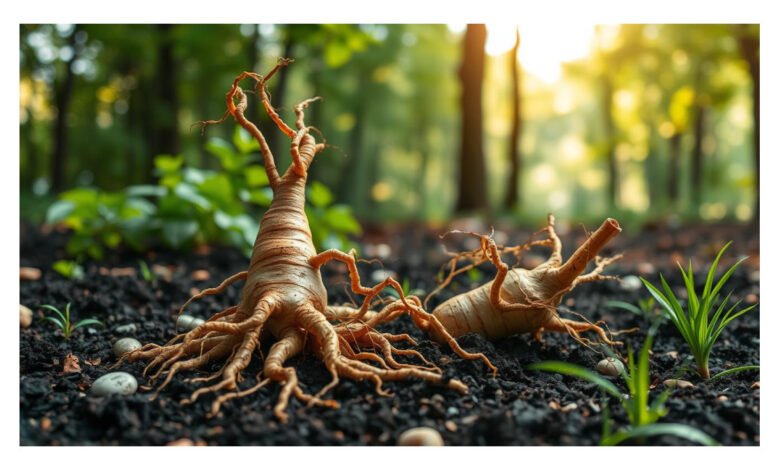
We introduce Panax ginseng, commonly called Korean ginseng or Asian ginseng. It’s a perennial mountain-forest species used for centuries in Korea, China, Japan, and the Russian Far East. The ginseng plant has distinct features like palmately compound leaves and red fruits. The root is the main part used for medicine and trade.
In this section, we explore the scientific and historical background. The name Panax comes from the Greek word for “panacea.” Early records date back to classical Chinese medicine. Modern studies (2004–2023) reveal how processing affects the root’s chemistry. Our goal is to make these facts and history easy to understand. This way, you can make informed choices about products and sources.
Key Takeaways
- Panax ginseng—often called Korean ginseng—is a distinct species valued for its characteristic root and long historical use.
- The ginseng plant is a perennial of mountain forests with identifiable leaves, flowers, and red fruits.
- Processing methods (peeling/sun-drying versus steaming/drying) produce white and red roots with different chemical profiles.
- The name Panax reflects historical belief in broad utility; modern science focuses on ginsenosides and non-saponin fractions.
- Understanding classification and processing helps you assess product authenticity and reported effects.
Taxonomic placement within Plantae and Araliaceae
The ginseng plant is placed in the Kingdom Plantae. It follows Tracheophytes, Angiosperms, Eudicots, and Asterids. It is in the order Apiales and family Araliaceae.
Taxonomic ranks help us understand relationships and guide research. A list shows where the Panax genus fits among related taxa.
- Kingdom: Plantae
- Clade sequence: Tracheophytes → Angiosperms → Eudicots → Asterids
- Order: Apiales
- Family: Araliaceae
- Genus: Panax
The Panax genus has a rich history. Carl Linnaeus named it after the Greek word “panax,” meaning panacea. This name reflects its traditional uses in East Asia.
Modern taxonomy uses many factors to define species in Panax. These include morphology, chemical profiles, geography, and voucher specimens. Names like Panax ginseng and P. quinquefolius are widely accepted.
Knowing botanical names helps avoid confusion. It supports clear communication in commerce, research, and conservation. This is crucial when comparing different types of ginseng.
Panax ginseng: species description and diagnostic characters
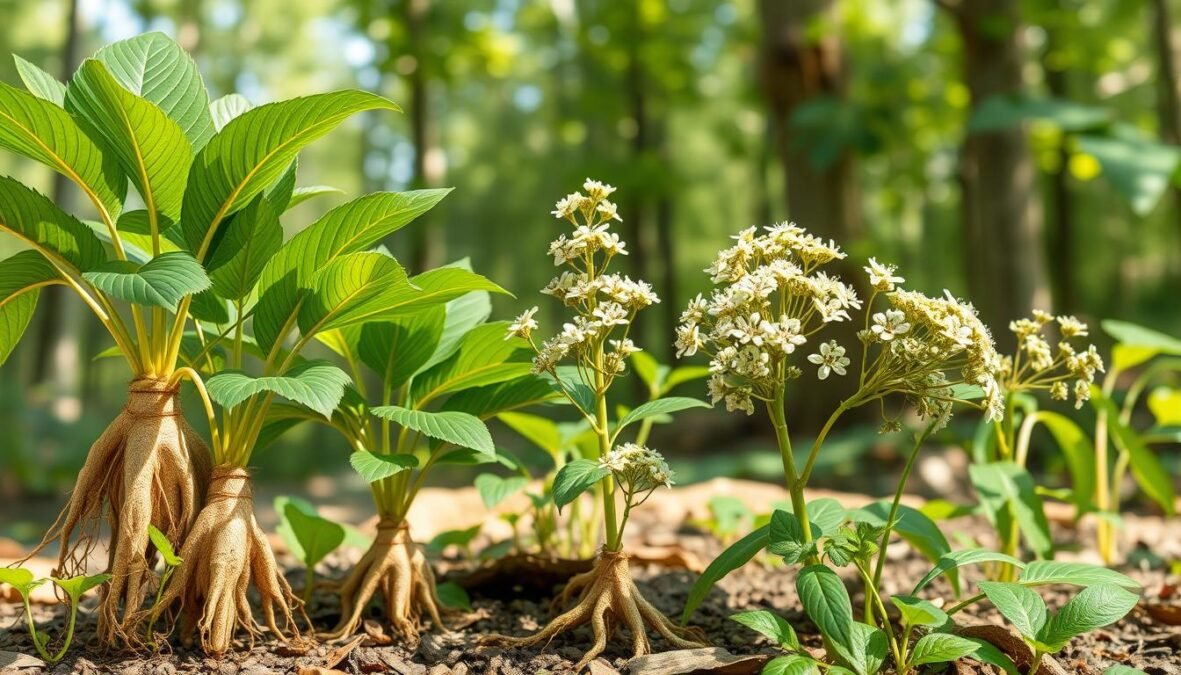
We describe key traits used to identify the ginseng plant in the field and in cultivation. Our goal is to give clear, practical points for distinguishing ages and forms of Korean ginseng without technical overload.
Vegetative morphology: leaves, leaflets, and growth habit
Plants are herbaceous perennials reaching about 30–60 cm tall in typical mountain-forest stands. Stems arise from a short crown and bear a terminal whorl of palmately compound leaves. Each aerial stem usually carries 3–6 leaves per season.
Leaf blades divide into 3–5 serrated leaflets. Leaflets are ovate to elliptic, with a pointed tip and conspicuous veins. Young cultivated specimens may show fuller foliage; wild plants often have a leaner habit shaped by shade and soil.
Reproductive structures: inflorescence, flowers, fruits, and seeds
Flowering is marked by a solitary terminal umbel. Peduncles commonly measure 15–30 cm and hold 30–50 small flowers in a compact cluster. Flowers are actinomorphic with a clearly two-carpellate ovary and distinct styles.
Fruits mature to a glossy red drupe about 4–5 x 6–7 mm. Inside each drupe a white, kidney-shaped seed develops. These reproductive characters help separate this species from close relatives when combined with leaf and root traits.
Root morphology: taproot shape, forked form, and storage root traits
The root system shows a prominent spindle- or cylinder-shaped taproot with one or two main lateral branches. Many specimens display a forked, anthropomorphic form that explains vernacular “man-shaped” descriptions.
Ginseng roots vary with age and cultivation. Harvested cultivated roots are commonly taken at 5–6 years; older wild roots often show more divisions and corky texture. Fresh root moisture is high—typically at or above 75%—while processed forms reduce moisture near 15% for long-term storage, altering firmness and color.
Chromosome number, cytology, and genetic notes
We summarize key findings in ginseng biology and management. Most studies on Panax ginseng show a diploid number of 2n = 48. This number is found in many sources, helping us understand ginseng genetics.
Studying chromosomes helps us understand Panax species better. Researchers look at chromosome shape, how they pair at meiosis, and their structure. This information is crucial for deciding on species limits and germplasm exchange.
Reported chromosome count and ploidy (2n = 48)
Studies on both cultivated and wild Panax ginseng agree on 2n = 48. This consistency is seen across East Asia. It makes chromosome count a reliable tool in taxonomic work and herbarium records.
Implications for breeding, variation, and conservation genetics
Knowing the chromosome number is key for breeding. It helps predict cross-compatibility and genetic segregation. Ginseng’s slow growth and late maturity affect breeding timelines and population size.
For conservation genetics, chromosome count guides sampling and molecular surveys. Plans that combine cytology with DNA markers help preserve genetic diversity. This improves the health of both wild and cultivated ginseng populations.
Range and native distribution in Northeast Asia
We explore the home of Panax ginseng in Northeast Asia’s cool, shaded slopes. Field guides and floras show it grows in the Russian Far East, Northeast China, and Korea. These mountain forests are key for ginseng’s survival and traditional harvesting.
Ginseng thrives in mid- to high-elevation woodlands. Here, the canopy keeps light out and soil moisture steady. The soil is perfect for ginseng’s slow growth, thanks to the forest’s rich humus.
Local climate and terrain influence ginseng’s spread. North-facing slopes, cool summers, and snow in winter help it survive. Farmers choose similar conditions for growing Korean ginseng.
Knowing ginseng’s likes is crucial for its protection. Keeping forests intact and avoiding soil damage helps. This way, we preserve ginseng habitats for both wild plants and cultural traditions.
Global cultivation, production regions, and protection status
We look at how ginseng is grown today and how we protect it. Ginseng grows slowly and is in high demand. This has shaped farming and policies.
Primary growing regions and commercial sources
South Korea, China, Russia, and Japan lead in ginseng farming. Farms vary from small family plots to large operations. Most ginseng sold today comes from these farms, not the wild.
Raw roots, extract, and powders are sold worldwide. Companies like Korea Ginseng Corp and Japan’s herbal processors ensure quality. They help manage exports.
Wild populations, conservation measures, and legal protection
Wild ginseng faces threats from over-harvesting and habitat loss. Russia and parts of China protect it with laws. These laws aim to slow its decline.
Conservation efforts promote growing ginseng. Programs like botanical gardens and seed banks help. They support genetic diversity and help restore wild populations.
Certification and trade rules help track ginseng origins. When buying, look for clear labels and third-party checks. This ensures it’s from legal, sustainable sources.
Related Panax species and common confusions with other “ginsengs”
We compare Panax species to help you choose the right ginseng supplements or extract. It’s important to know the difference. Plants vary in where they grow, their chemistry, and how they’re used.
We’ll look at Panax quinquefolius and Panax notoginseng. Then, we’ll compare them with Eleutherococcus senticosus, known as “Siberian ginseng.”
Comparison with Panax quinquefolius and Panax notoginseng
Panax quinquefolius, or American ginseng, grows in eastern North America. It has paler roots and a different mix of ginsenosides than Asian ginseng. It’s used in supplements for calming and restorative effects.
Panax notoginseng grows in China’s Yunnan and Guangxi provinces. It’s known for its unique saponin pattern. It’s used in separate products from American and Asian ginseng.
Distinction from Eleutherococcus senticosus
Eleutherococcus senticosus is in the same family as Panax but is not a Panax species. It has eleutherosides, not ginsenosides. It was once called “Siberian ginseng,” causing confusion.
It’s crucial to check product labels and third-party tests for quality. Knowing the exact species ensures you get the right ginseng extract and its benefits.
Historical records in East Asia and classical texts
We explore ginseng history through ancient writings. These texts show how its use and cultivation evolved. Early Chinese works detail the root’s medicinal uses and how it was prepared.
Early Chinese references
Shen Nong’s Pharmacopoeia, from the second century, lists ginseng as a key medicine. It explains basic preparation methods. Later, Li Shizhen’s Compendium of Materia Medica (1596) provided more details on the root’s appearance and how to store it.
Korean historical sources
In Korea, the plant was known as shim and hongsam. Records from the Goryeo and Joseon periods talk about growing it. They also mention how to transplant and propagate it.
Japanese records and regional botany
Japanese texts mention local uses and cultivation of the same species. Scholars and merchants shared knowledge, spreading cultivation and interest in ginseng tea. This created a botanical tradition across China, Korea, and Japan.
| Document or Source | Region | Notable Contribution |
|---|---|---|
| Shen Nong’s Pharmacopoeia (circa 196) | China | Earliest systematic listing of medicinal roots, processing notes for the ginseng plant |
| Compendium of Materia Medica (Li Shizhen, 1596) | China | Detailed classifications, quality grades, and preparation methods for root products |
| Goryeo and Joseon annals (selected records) | Korea | Descriptions of cultivation techniques, references to shim and hongsam, emergence of red ginseng processing |
| Regional Japanese botanical records (various) | Japan | Notes on local use, occasional cultivation, and integration of knowledge with continental sources such as ginseng tea traditions |
Introduction and awareness in the Western world
We explore how the ginseng plant knowledge spread from East Asia to Europe and the Mediterranean. Early interactions sparked curiosity. Traders, travelers, and scholars noted the roots and remedies they found.
This laid the groundwork for ginseng’s early history in Western records and botanical collections.
Medieval transmission routes via Arab traders and early European accounts
Arab merchants carried goods and reports along the Silk Road. They brought Chinese medicinal roots into Middle Eastern scholarship.
Figures like Ibn al-Rāzī and others shared descriptions. These reached European intellectuals through translations and trade. They introduced the idea of a valuable root with unique properties.
Renaissance onward: Jesuit reports and subsequent botanical descriptions
Explorers and missionaries deepened Western knowledge. Marco Polo shared early traveler observations in the 13th century. Portuguese and Dutch trading routes expanded direct contact with East Asia.
Jesuit missionaries in the 17th and 18th centuries provided botanical notes and specimens. Pierre Jartoux and others described “gin-seng” in letters and collections. They helped include Panax ginseng in Linnaean-era taxonomies.
| Period | Key Agents | Type of Contribution |
|---|---|---|
| Medieval | Arab traders, scholars | Written descriptions transmitted via translations; initial awareness in the Mediterranean |
| Late medieval–early modern | Marco Polo, merchants | Traveler accounts and trade brought physical samples and stories to Europe |
| Renaissance–Enlightenment | Jesuit missionaries, botanists | Detailed observations, specimens, and letters that fed botanical classification |
| 18th–19th century | Linnaean scholars, herbaria curators | Formal description and incorporation of Panax ginseng into scientific collections |
Forms of processed root: raw, white, and red preparations
We explain the different forms of ginseng roots so you can spot them on labels or in research. The choices made after picking change how the root looks, lasts, and what scientists study in ginseng extract and tea.
Definitions and processing steps for raw (fresh) root
Raw root is fresh and has a lot of moisture—over 75%. It’s soft and not good for long storage. It’s usually processed right after it’s picked.
Fresh roots are often used for quick extracts or traditional teas. To make products that last longer, like bottled extract, they first turn raw root into white or red.
Peeling and sun-drying characteristics and storage parameters
White root is made by peeling mature roots, usually 4- to 6-years-old, and then drying them in the sun. They dry to about 15% moisture. The root keeps its shape but gets lighter in color.
Once dried, white root keeps well in cool, dry places. Good packaging helps keep moisture out and protects the root for ginseng tea or lab tests.
Steaming, drying, and changes to chemical profiles during processing
Red root is made by steaming unpeeled roots and then drying them. This makes them compact and pink–brownish, with about 15% moisture. The heat makes them last longer and more stable.
Steaming and drying change the ginsenosides in the root. This means the root’s chemical makeup changes. These changes are important in studies of ginseng extract and in checking the quality of Korean ginseng.
Here’s a quick guide to help you choose:
| Attribute | Raw (fresh) | White root | Red root |
|---|---|---|---|
| Harvest age | Usually 3–6 years; immediate post-harvest | Commonly 4–6 years | Commonly 4–6 years |
| Processing steps | None beyond cleaning | Peeled thinly, sun-dried to ≤15% moisture | Steamed unpeeled, then dried to ~15% moisture |
| Appearance & texture | High moisture, soft | Light color, preserved shape, brittle | Pink–brownish, compact, firm |
| Typical storage life | Short; must be processed quickly | Years if kept dry and cool | Extended; reports of decades under ideal storage |
| Phytochemical profile | Reflects native ginsenoside mix | Minor conversion from drying; profile close to native | Significant heat-driven conversion to minor ginsenosides |
| Common end uses | Immediate decoctions, fresh preparations | Ginseng tea, dried root products, some extracts | Standard material for many Korean ginseng preparations and extracts |
When looking at labels and studies, remember how processing changes things. Studies on ginseng extract should say if it was raw, white, or red. This tells you which ginsenoside profile was studied and which products, from tea to supplements, the results apply to.
Phytochemistry: major classes of compounds in the plant
We give you a quick look at what makes up the ginseng plant. This helps you understand lab reports and product labels. The main stuff is saponins called ginsenosides. But, other parts and nutrients also play a role.
Ginsenosides come in two big groups: protopanaxadiol (PPD) and protopanaxatriol (PPT). You’ll find Rb1, Rb2, Rc, and Rd a lot in ginseng extracts. Smaller amounts of Rg2, Rg3, Rg5, and Rk1 are also there, more after processing.
Now, let’s talk about other important stuff. Polysaccharides, volatile oils, and sterols add to the root’s good stuff. You’ll find starch, pectin, and B-complex vitamins. Even trace minerals like zinc and iron are there, but in small amounts.
Gintonin is a special part that scientists are really interested in. It’s different from the usual ginsenoside stuff. Knowing about gintonin and saponins helps us understand what we get from ginseng.
Getting a full picture of the plant means looking at everything. This includes ginsenosides, polysaccharides, volatile oils, and minerals. It’s good to see both ginsenoside and non-saponin info in reports. This way, you can compare different products and batches better.
Variability of phytochemical profiles across species and processing
We look at how chemical makeup changes in different Panax species and through processing steps. Small changes in how it’s grown, when it’s picked, and where it comes from affect its ginsenoside content. It’s key to report where it comes from and how it’s processed when comparing samples.
Species-specific ginsenoside patterns and chemotaxonomic markers
Different ginseng types have unique saponin patterns. Panax ginseng and Panax quinquefolius share many ginsenosides but differ in their amounts. The Rb-group and Rg-group proportions often tell Asian and American ginseng apart. Some minor ginsenosides also serve as markers to verify species authenticity.
When labs do ginsenoside profiling, they can spot markers for species, origin, or processing. We suggest pairing botanical checks with chemical analysis to avoid misidentification and adulteration.
Effect of steaming/drying on conversion of ginsenosides (major to minor forms)
Steaming and controlled drying, used in making red root, lead to chemical changes. Major ginsenosides like Rb1, Rb2, Rc, Rd, Rg1, and Re turn into minor compounds like Rg2, Rg3, Rg5, Rk1, Rk3, Rh1, and Rh4 through heat.
These changes alter the ginseng extract’s profile and how it’s analyzed. Labs should mention processing methods when publishing ginsenoside results. This helps understand if differences come from biology or processing.
Below is a concise summary of common profiles and processing effects. It’s useful for researchers and product developers to evaluate raw materials and finished extracts.
| Material | Typical dominant ginsenosides | Processing influence | Analytical note |
|---|---|---|---|
| Fresh Panax ginseng root | Rb1, Rb2, Rc, Rd, Rg1, Re | Minimal conversion if sun-dried; retains major saponins | Baseline for comparing processed samples; report harvest age |
| Red ginseng (steamed Panax ginseng) | Increased Rg3, Rg5, Rk1, Rh1; reduced majors | Steaming and drying induce dehydration and deglycosylation | Processing history required for proper ginsenoside profiling |
| Panax quinquefolius (American ginseng) | Rb-group prominence; lower Rg1/Re ratio than Asian ginseng | Drying methods alter minor component levels | Chemotaxonomic markers help differentiate from Asian types of ginseng |
| Commercial ginseng extract | Concentration varies—standardized extracts often labeled by marker ginsenoside | Extraction solvent and temperature shape the final profile | Full ginsenoside profiling advised instead of single-marker claims |
Analytical methods and quality control for botanical material
We share ways to test ginseng for research, regulators, and makers. Good quality control means checking chemical makeup, species, and physical state of roots.
Chromatographic and spectrometric techniques
Labs use high-performance liquid chromatography and liquid chromatography–mass spectrometry for ginsenoside analysis. These methods identify key compounds and minor ones, and spot gintonin signals.
Nuclear magnetic resonance and mass spectrometry are used for new compound structures. It’s key to validate methods for accuracy and detection limits when testing ginseng products.
Authentication and detection of adulteration
Checking species identity involves looking at shape, DNA, and chemical makeup. DNA helps tell Panax ginseng from Panax quinquefolius and other plants.
Chemical fingerprints are used to check ginseng products and roots. Reference databases help ensure correct names and sources.
Standards for moisture, storage, and morphological grading
Standards for processed roots aim to keep quality for testing and sale. Moisture levels below 15% are common to prevent growth and changes.
Morphological grading looks at size, fork shape, and surface. Controlled storage keeps quality consistent across batches.
Here’s a comparison to help with quality control and research.
| Quality Domain | Recommended Method | Key Metrics | Relevance for Stakeholders |
|---|---|---|---|
| Ginsenoside profiling | HPLC; LC–MS; targeted MS/MS | Peak identity, relative abundance, LOQ/LOD | Supports label claims for ginseng extract and product standardization |
| Structural ID of novel compounds | NMR + HRMS | Structural assignment, coupling constants, accurate mass | Enables publication and regulatory dossiers for unique markers |
| Species authentication | DNA barcoding; morphological keys; chemotype fingerprinting | Sequence matches; diagnostic morphological traits; chemometric patterns | Prevents substitution in ginseng roots and finished ginseng supplements |
| Moisture and storage | Gravimetric moisture; controlled storage records | % moisture (≤15%), humidity, temperature logs | Ensures shelf stability and reliable downstream ginsenoside profiling |
| Morphological grading | Visual inspection against standard charts; photographic records | Size class, forked vs. single taproot, surface quality | Facilitates trade grading and traceable sourcing of ginseng roots |
Research methodologies in Panax studies
We explain common methods in ginseng research. This helps you understand study quality and replicate findings. It’s important to report on the source, processing, and analysis of the ginseng plant or extract.
Taxonomic and morphological approaches
Herbarium vouchers are key in field taxonomy. We note GPS coordinates, habitat details, and population sizes. This captures the variation within species.
Microscopy, both light and scanning electron, is used to study the plant’s structure. This helps distinguish between Panax species. It’s crucial to deposit vouchers in recognized herbaria for future comparisons.
Phytochemical workflows
Extraction methods are defined by solvents, temperatures, and sample history. We note if roots were fresh, dried, or steamed. This affects the ginsenoside content.
Fractionation and isolation use column chromatography and preparative HPLC. Mass spectrometry and NMR are used to identify ginsenoside structures accurately.
Experimental design for lab and preclinical work
Botanical authentication is essential before experiments. Voucher numbers and DNA barcodes confirm identity. We standardize doses by mass and marker concentration in the extract.
Controls include vehicle, authenticated reference material, and process-matched blanks. Randomization and blinding reduce bias in animal or in vitro assays.
| Study Phase | Key Methods | Essential Reporting |
|---|---|---|
| Field taxonomy | Herbarium vouchers, GPS mapping, microscopy | Voucher number, collection date, habitat notes |
| Phytochemical analysis | Solvent extraction, column chromatography, MS/NMR | Processing history, solvent system, instrument settings |
| Preclinical testing | Standardized dosing, randomized groups, blinded assessment | Source of ginseng extract, marker quantification, sample size |
| Data synthesis | Chemical fingerprinting, statistical reproducibility checks, meta-analysis-ready metrics | Raw data availability, analytical methods, calibration standards |
Safety observations and reported adverse effects from literature
We look at safety signals for Panax ginseng to help you understand risks. Reports range from mild symptoms to serious events in certain cases. It’s important to choose products carefully and monitor them, not make claims about ginseng’s health benefits.
Documented adverse events and case reports
Studies and reports link long-term or high-dose ginseng use to heart issues like high blood pressure and irregular heartbeats. Some users experience insomnia, irritability, dizziness, and headaches due to its effects on the brain.
Some people taking ginseng supplements report stomach problems like diarrhea and discomfort. There are also concerns about blood sugar levels and pregnancy.
There are reports of ginseng affecting reproductive and kidney health. Some women experience irregular periods and bleeding between periods. There are also cases of kidney problems, though it’s not clear if ginseng caused them.
Interactions with medications and populations of concern
Reviews highlight possible interactions between ginseng and drugs. It may affect how warfarin works, change blood sugar levels, and interact with medications for sleep or focus. Always check with your doctor about interactions with statins, blood thinners, and diabetes medications.
People who are pregnant or breastfeeding should be cautious. Those with autoimmune diseases, bleeding issues, heart problems, or cancer should talk to a doctor before using ginseng. Children should not use concentrated ginseng products.
Duration of use and regulatory guidance regarding safety monitoring
Experts suggest using ginseng for short periods and taking breaks. Regulatory bodies want clear information on product identity, dose, and use in safety studies.
Keep a record of any side effects, including the ginseng product name, form, dose, and how long you’ve been using it. Always check your blood pressure, blood sugar, and watch for unusual bleeding when starting ginseng supplements.
Key practical points
- Start with low doses and short trials when testing ginseng extract.
- Inform your healthcare provider about all supplements to reduce interaction risk.
- Stop use and seek care if you experience severe hypertension, marked dizziness, or unusual bleeding.
How to compile an evidence-focused article on Ginseng for a US audience
We start with a solid plan to sort out real facts from opinions. We aim for short sections on the plant’s type, look, chemical makeup, how it’s processed, research methods, and safety. We use simple language so readers can understand the plant’s details and research findings easily.
Selecting reliable primary sources
First, we look at trusted databases like GRIN, POWO, IPNI, and GBIF for plant names and where they grow. We also check out journals like Journal of Ginseng Research, Experimental Gerontology, and Food & Medicine Homology for solid research and reviews.
For plant samples and summaries, we turn to places like USDA ARS germplasm information and National Center for Complementary and Integrative Health. They give us the lowdown on safety and rules. When talking about ginseng extract or supplements, we make sure to mention the original research and where the samples came from.
Structuring content for clarity and rigor
We start with the plant’s type and how to tell it apart. Then, we dive into its look and where it grows to make ecological and conservation points clear.
Next, we talk about the plant’s chemistry—what compounds it has, how they’re analyzed, and how processing affects them. We explain the research methods used so readers can judge the quality of the data. We separate lab results from real-world studies when discussing ginseng research.
Citation practices, neutrality, and claim control
We use clear, consistent citations for every fact we share. We give credit for lab methods, sample origins, and how the plant was processed. We avoid making health claims without solid clinical backing. Instead, we report on study results and limitations when talking about ginseng supplements or trials.
We also share any safety concerns or regulatory notes that US readers should know. We remind readers to talk to healthcare pros before using ginseng extract or taking supplements for a long time. We aim to inform, not promise, so readers can make smart choices.
Conclusion
We’ve looked into Panax ginseng, a plant found in East Asia. It has unique traits and a chromosome count of 2n = 48. This plant has been studied for a long time in botanical and medicine texts.
The ginseng plant has clear differences in its leaves and roots. These differences help us tell species apart. They also guide how we grow and protect these plants.
Phytochemistry is key to understanding ginseng roots. The ginsenoside profile and other compounds like gintonin change with the plant and how it’s processed. It’s important to use the right methods to study these compounds.
Authors and readers in the U.S. should use reliable sources and follow scientific studies. They should explain how they processed and analyzed the samples. It’s also important to talk about any safety concerns without exaggerating the benefits.
When thinking about using ginseng, it’s good to look at the evidence. We should also consider any known side effects and the quality of the product.
Ginseng is a fascinating subject that we’re still learning about. We’ll keep studying its taxonomy, phytochemistry, and research methods.